
Our verdict in three lines
Do not start a new project on Flowise. Its team announced on July 29, 2026 that it was winding down, and the official end of life was August 31, 2026.
The Apache 2.0 code remains on GitHub in a read-only archive, so a running instance keeps working, without fixes or security patches from the Flowise team.
If you are choosing today, pick a maintained builder you can self-host. If you already run Flowise, plan a migration at your own pace.
Flowise still makes sense if
- You have a working internal instance and a developer who can maintain a fork
- Your flows are internal tools with no sensitive data exposed to the internet
Move on if
- You are starting from zero: see open source AI agents you can self-host
- Your instance faces customers or the public internet
- You relied on the Flowise team for updates and support
- Entry price
- Discontinued
- Billed in
- Predictions (cloud plans)
- Free plan or trial
- Free self-hosted edition
- Integrations
- Not stated
- Self-hosting
- Yes
- Price checked
- Nov 15, 2026
What happened to Flowise?
The banner on flowiseai.com reads "We're sunsetting Flowise." It links to a note titled The Future of Flowise, signed "Henry & Flowise Team", which gives the reason in their own words: developers are "increasingly relying on new coding agents" for complex tasks, and "the typical rigid workflow low code approach quickly hits the limit when it comes to complexity".
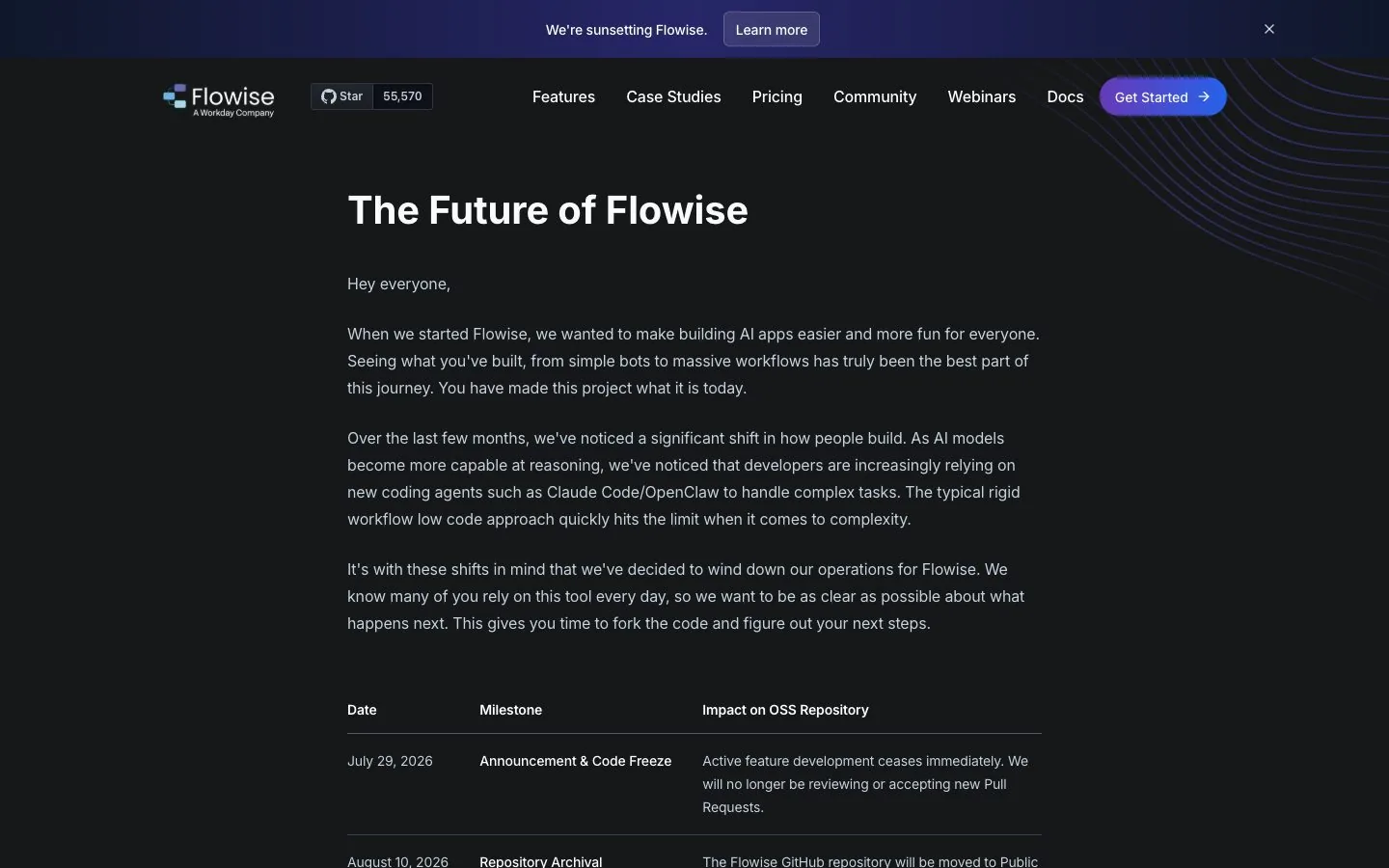
The timeline in that note:
- July 29, 2026: announcement and code freeze. No new features, no pull requests reviewed.
- August 10, 2026: the GitHub repository moves to public archive status; npm packages and Docker images are marked deprecated.
- August 31, 2026: end of life. The core team leaves Discord and GitHub.
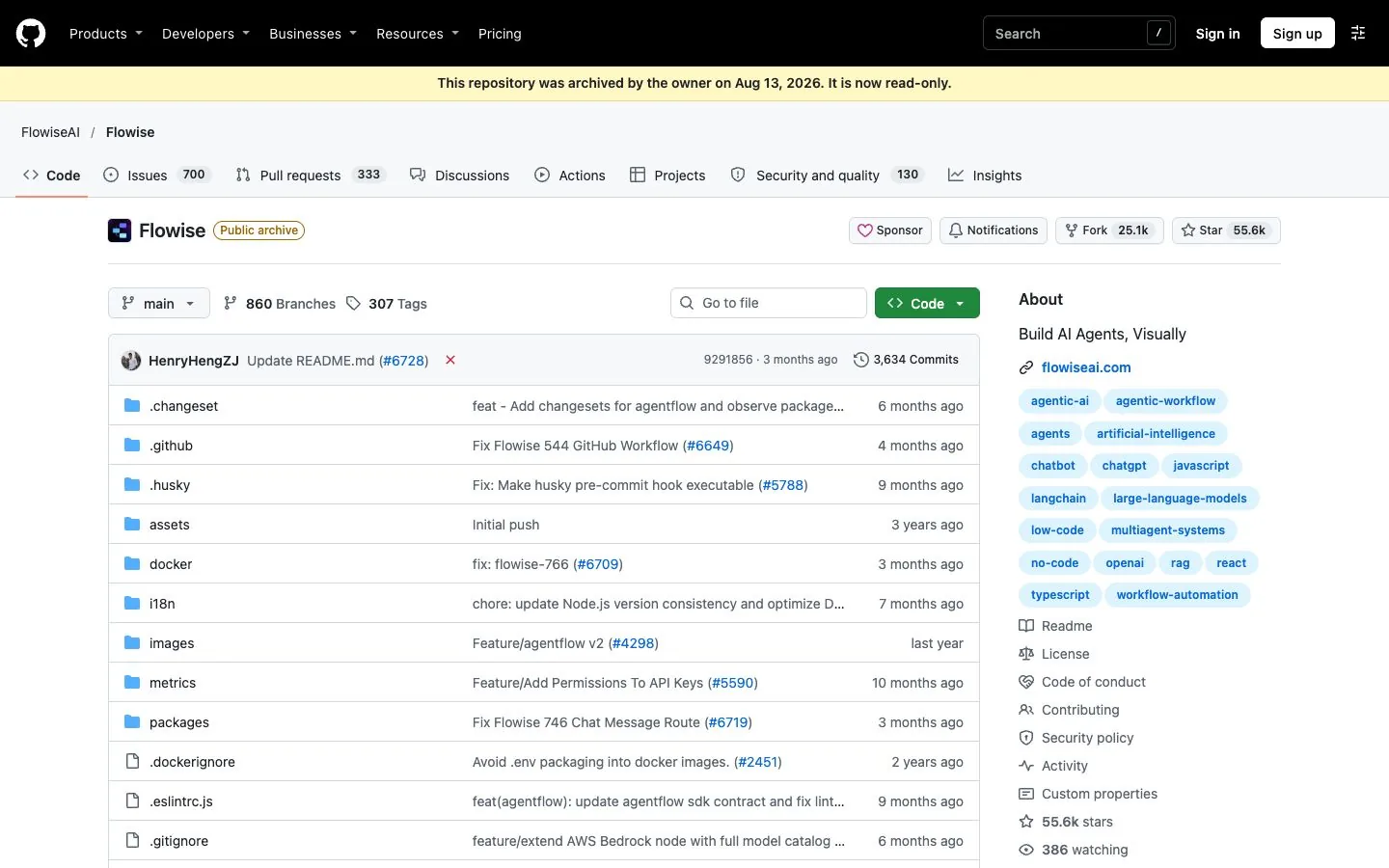
GitHub itself confirms it. The repository page states that it "was archived by the owner on Aug 13, 2026" and is now read-only.
Can you still use Flowise?
Technically, yes. The notice says the source code "will still remain on Github and the Apache 2.0 licensed code is yours to keep building on", and it encourages teams to fork the repository. Nothing switches off a self-hosted instance.
Practically, you are now the maintainer. No one upstream will patch a vulnerability in a dependency, update a model connector when a provider changes its API, or answer an issue. For an internal prototype that may be acceptable for a while. For anything that touches customer data or sits on the open internet, it is a risk that grows every month.
What about Flowise Cloud and its pricing?
On November 15, 2026 the homepage still displayed the old pricing section under the sunset banner: Free ($0, 2 flows and 100 predictions a month), Starter ($35 a month, 10,000 predictions) and Pro ($65 a month, 50,000 predictions). We would not subscribe to a hosted plan of a product whose team has announced its departure, and the notice does not say how long the hosted service will run. If you are a paying cloud customer, export your flows now and ask Flowise directly about your account.
What was Flowise good at?
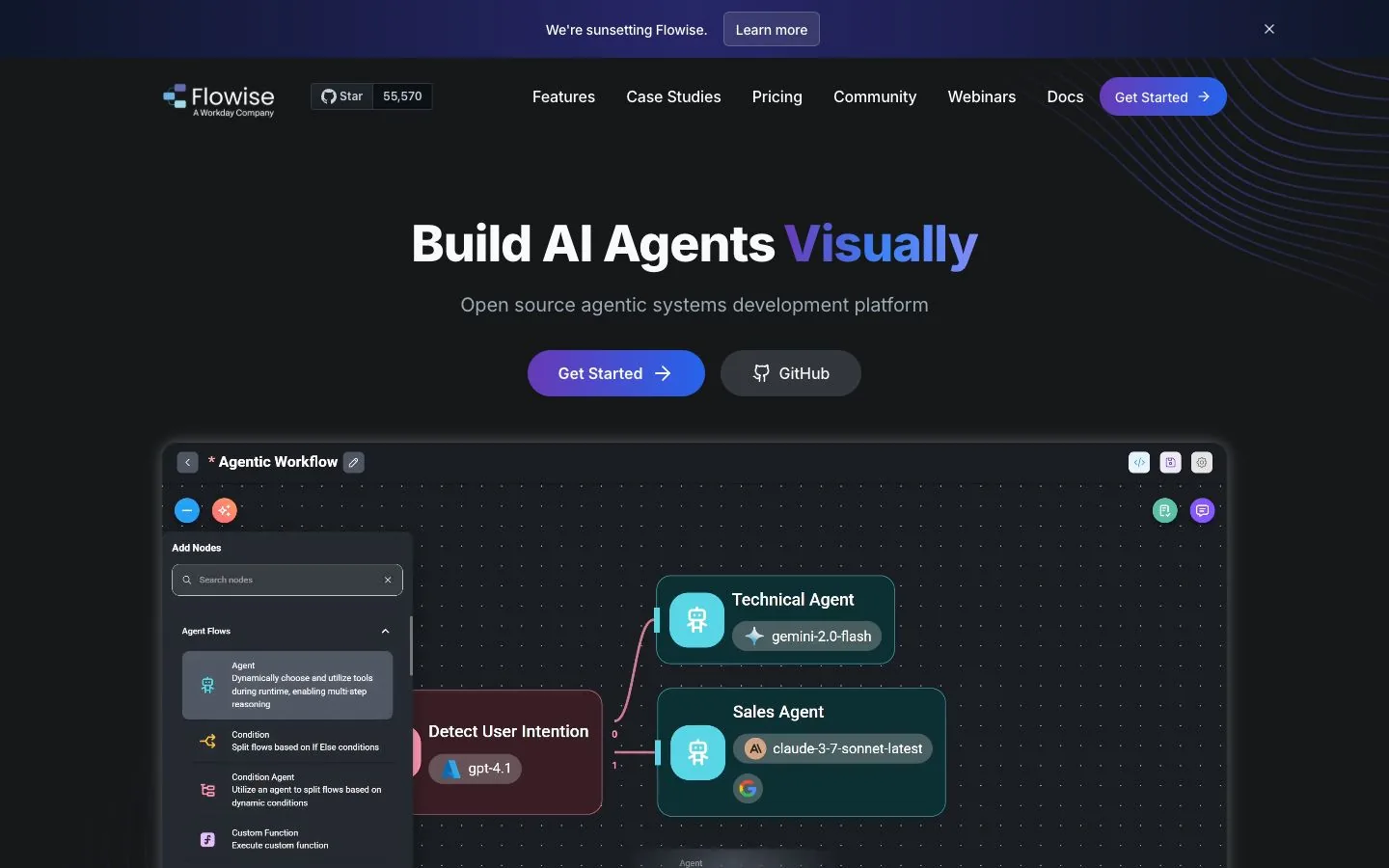
It deserves a fair word. Flowise let you build agents and RAG chatbots by connecting blocks on a canvas: Agentflow for multi-agent systems, Chatflow for single assistants with tool calling and document retrieval, human-in-the-loop review, execution traces, and an API, SDK and embeddable chat widget. The site lists support for 100+ LLMs, embeddings and vector databases. With 55,600 stars on GitHub, it was many people's first agent builder. That is exactly why the shutdown matters.
Which Flowise alternatives should you look at?
It depends on why you chose Flowise in the first place.
- You wanted a free, self-hosted visual builder for agents and RAG: Langflow is the closest in spirit. It is MIT-licensed, Python-based, and exposes each flow as an API or MCP server.
- You wanted agents plus real business automations: n8n has an AI Agent node inside a full workflow tool with 500+ integrations and a self-hosted Community Edition. See Flowise vs n8n.
- You wanted an app studio with a knowledge base: Dify offers workflows, agents and document processing, on its cloud or self-hosted with Docker.
- You wanted simple flows and a free hosted tier: Activepieces has a free plan and an open-source edition.
The licenses differ, and "self-hosted" does not always mean "open source". We compare them line by line in open source AI agents: builders you can self-host, and our n8n alternatives guide covers the same family from the other side.
How should you plan a migration?
- Export every flow as JSON from your instance and store the files in version control today, before anything else.
- List what each flow depends on: which model, which vector store, which credentials, which custom code.
- Rebuild the simplest flow in the candidate tool first. A flow is a design, not a file format, so expect to rebuild instead of import.
- Run old and new side by side on real inputs before you switch traffic.
- Keep the old instance offline but intact for a few weeks, then archive it.
Questions to ask yourself before you decide
- Is my Flowise instance reachable from the internet? If it is, treat the move as urgent: nobody upstream patches it anymore.
- Does it handle customer or personal data? Unpatched software and personal data are a bad pair, whatever the size of the team.
- Do I have a developer who could patch a fork? The Apache 2.0 code is yours to fork, but a fork needs someone who follows the security notices of everything it depends on.
- What is my deadline? The notice gives dates for the code freeze, the archive and the end of life, and none for the hosted service.
- Would a hosted tool be cheaper than maintaining this myself? Count the hours: the license was free, the upkeep never was.
Flowise pros and cons
What we like
- Apache 2.0 code remains available
- Existing instances keep running
- Flows can be exported as JSON
What to watch
- No updates or security fixes from the team
- Repository archived and read-only
- npm packages and Docker images deprecated
- Unclear future for the hosted plans
Flowise alternatives: how it compares
These are the highest-scoring builders on this site that you can still self-host, next to Flowise for reference.
| Compared |  Activepieces9.4/10From $20/mo checked Nov 15, 2026 |  Langflow9.0/10Free, open source checked Nov 15, 2026 | ||
|---|---|---|---|---|
| Type | Low-code, open source (archived) | Low-code, source-available | No-code, open source | Developer tool, open source |
| Entry price | Discontinued | From $24/mo | From $20/mo | Free, open source |
| Billed in | Predictions (cloud plans) | Workflow executions | Credits (one per run) | No platform fee |
| Free plan or trial | Free self-hosted edition | Free self-hosted edition | Free plan | Free self-hosted edition |
| Integrations announced | Not stated | 500+ | 770+ | Not stated |
| AI models | 100+ LLMs, embeddings and vector databases | Connect any model with your own key; Cloud plans also include AI models without API keys | Built-in fast, smart and frontier models, or your own AI keys on Plus and up | All major LLMs and vector databases, with your own keys |
| Agents or workflows | Agents and workflows | Agents and workflows | Agents and workflows | Agents and workflows |
| Knowledge base / memory | Yes | Yes | Not stated | Yes |
| Human approval | Yes | Yes | Yes | Not stated |
| Self-hosting | Yes | Yes | Yes, limited | Yes |
| API / MCP | API, SDK and embedded chat widget | Public API, CLI, webhooks, MCP server trigger | API, SDK and MCP on every plan | Built-in API and MCP servers for every flow |
| Built for | Teams with a running Flowise instance that need a migration plan | Technical founders and ops people who want control and a low bill at volume | Small teams that want Zapier-style flows with a free tier and an exit to self-hosting | Developers who are comfortable with Python and want no license bill |
| Official page | Read the notice at Flowise | Check price at n8n | Check price at Activepieces | Get Langflow free |

- Flowise vs n8n: the side-by-side, with prices checked Nov 15, 2026.
- n8n vs Zapier: the side-by-side, with prices checked Nov 15, 2026.
- Best AI agent builders: the full ranking of 13 tools.
- n8n alternatives: 7 tools to consider, and when to stay
- Open these tools in the comparison tool
Flowise FAQ
Is Flowise shut down?
The project was wound down by its team: code freeze on July 29, 2026, repository archived in August, end of life on August 31, 2026, according to the official notice at flowiseai.com/sunset.
Is Flowise still free and open source?
The code is still on GitHub under the Apache 2.0 license and can be forked, but the repository is a read-only archive and receives no fixes from the Flowise team.
What is the best Flowise alternative?
For a free self-hosted visual builder, Langflow; for agents inside business automations, n8n; for an app studio with a knowledge base, Dify. All three are compared in our self-hosted ranking.
Why does Flowise have no score here?
Our formula scores products a team can adopt today. A discontinued tool is listed for information and is not rated or ranked.
Sources
Everything on this page comes from Flowise's own pages, read on November 15, 2026. Where a page does not state something, we say so.